
TREE RISK ASSESSMENT
Great Western Tree Care’s TRAQ-certified experts provide tree risk assessment that deliver practical, preservation-focused solutions to keep your property safe while retaining valuable trees whenever possible.

Comprehensive Tree Risk Assessment Services in Denver, CO
Great Western Tree Care provides professional tree risk assessment services for residential properties across the Denver metro area. Trees provide shade, beauty, and property value, but they also represent potential liability when structural defects, disease, or root compromise create conditions for failure. Our TRAQ-qualified arborists (Tree Risk Assessment Qualification, credentialed by the International Society of Arboriculture) evaluate tree structural integrity using the ISA Best Management Practices for Tree Risk Assessment framework, producing documented reports that identify hazards, quantify risk levels, and recommend specific mitigation actions, whether that involves targeted pruning, cabling and bracing, pest treatment, or removal. Call (720) 535-8769 to schedule your tree risk assessment.
Purpose & Scope
Identify Hazardous Trees
Detect trees with structural defects, diseases, or pests that may pose a risk to people, property, or infrastructure.
Evaluate Risk
Assess the likelihood of failure and potential consequences to determine the urgency of mitigation actions.
Mitigate Risk
Develop and implement strategies to reduce or eliminate identified risks, such as pruning, cabling, or removal.
Document Findings
Maintain records of TRA activities, recommendations, and follow-up actions to ensure accountability and continuous improvement.
Tree Health Evaluation
Visual Tree Assessment (Level 1 and Level 2)
Our risk assessment process follows the ISA three-level framework. Level 1 assessments are limited visual surveys that identify obvious defects across a population of trees, suitable for property-wide screening. Level 2 assessments provide detailed individual tree evaluations including full 360-degree trunk inspection, crown architecture analysis, root flare examination, and target zone identification. Most residential tree risk assessments are Level 2, providing the depth of evaluation needed to make informed management decisions for individual trees that occupy positions near homes, driveways, walkways, and outdoor living areas.
Structural Defect Identification
Our TRAQ-qualified arborists identify and document structural defects that increase failure probability. These include codominant stems with included bark unions, one of the most common failure points in Front Range shade trees. Cracks in the trunk or major scaffold branches. Cavities and decay pockets that compromise cross-sectional strength. Cankers from disease organisms like cytospora that weaken branch and trunk tissue. Root plate defects including severed roots, girdling roots, and soil grade changes that undermine stability. Each defect is evaluated in context: a cavity on a tree over an unused area represents different risk than the same cavity on a tree over a children's play area.
Root Zone Assessment
Root system health directly determines tree stability. We evaluate root plate condition by examining soil heaving, root exposure, and trunk lean. We identify root damage from construction, grade changes, soil compaction, and trenching that may have severed anchoring roots. For trees in Highlands Ranch, Lone Tree, and other communities where utility installations and hardscape construction frequently impact root zones, we assess whether root loss has compromised the tree's structural anchorage.
Canopy and Crown Assessment
Canopy condition reveals both health status and structural risk. We evaluate crown density, dieback patterns, leaf size and color, epicormic sprouting, and branch attachment quality throughout the canopy. Asymmetric canopy development, where most foliage grows on one side due to light competition or storm damage, creates loading imbalances that increase failure risk during wind events. Dead branch distribution identifies immediate hazards requiring pruning regardless of overall tree condition.
Hazard Tree Identification
What Makes a Tree Hazardous?
A hazard tree is defined by two factors: a tree with structural defects that increase the likelihood of failure AND the presence of a target, a person, structure, vehicle, or other item of value, within the potential impact zone. A tree with significant decay in a remote forest clearing poses minimal risk because no targets exist. The same tree in a backyard adjacent to a deck where a family gathers daily represents a high-risk situation. Our assessments evaluate both the likelihood of failure and the consequences of failure to produce meaningful risk ratings.
Common Hazard Tree Indicators in Denver
Denver metro properties face specific hazard tree conditions driven by local climate, soil, and species factors. Heavy spring snowstorms (April–May) load canopies with wet snow that exploits weak branch attachments. Chinook wind events generate sustained 50+ mph gusts along the Front Range. Freeze-thaw cycles create progressive frost cracking in trunk tissue. Clay soil saturation during spring snowmelt reduces root anchorage when combined with wind loading. Drought stress from consecutive dry summers weakens wood fiber strength and promotes secondary pest colonization. These regional factors increase baseline failure risk for all trees and make professional assessment essential for properties with large trees near structures.
Risk Rating and Prioritization
We assign risk ratings following the ISA Tree Risk Assessment matrix, combining likelihood of failure, likelihood of impact, and consequences of failure into an overall risk rating of Low, Moderate, High, or Extreme. This framework provides property owners and insurance professionals with standardized, defensible risk classifications that support management decisions. Trees rated High or Extreme require prompt mitigation, typically within 30–90 days depending on the specific defect.
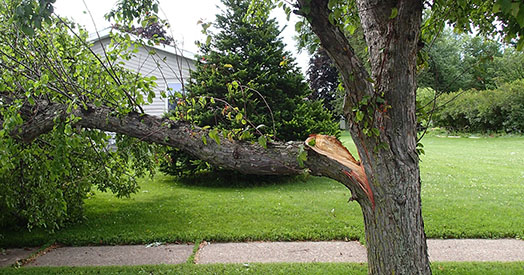
[Image: Tree defect inspection showing codominant stems.
Unique To Colorado
Tree risk assessment in Colorado is critical—extreme weather, heavy snow loads, and drought stress can weaken trees over time, making proactive evaluations key to preventing damage or failure.
How Much Does A Tree Risk Assessment Cost in Denver, CO?
Tree risk assessment costs depend on the number of trees, assessment level, and whether written reports are required. Here are general ranges:
Single Tree Level 2 Assessment (with verbal report): $150–$300 depending on tree size and complexity
Single Tree Level 2 Assessment (with written ISA-format report): $250–$500 per tree including detailed findings, risk rating, photo documentation, and mitigation recommendations
Property-Wide Level 1 Screening (population assessment): $300–$800 depending on tree count and property size
Multi-Tree Detailed Assessment (3–10 trees with written reports): $500–$2,000+ depending on scope and reporting requirements
Advanced Assessment (Level 3, with diagnostic tools): $500–$1,500+ per tree for assessments requiring resistograph drilling, sonic tomography, or root collar excavation
Cost factors specific to the Denver metro area include:
- Properties in Castle Pines and Roxborough Park with extensive tree inventories on larger lots benefit from property-wide screening assessments
- Insurance companies and real estate transactions may require ISA-format written reports with specific documentation standards
- Properties with recent construction activity near mature trees often need post-construction root zone assessments to evaluate destabilization risk
• Storm-damaged trees in Aurora, Centennial, and Englewood may require expedited assessment for insurance claims or immediate hazard mitigation
Tree Risk Assessment by Property Type
Residential Properties with Mature Trees Near Structures
The most common scenario driving risk assessment requests is a mature tree positioned near a home, garage, fence, or outdoor living area. Property owners in Parker, Castle Rock, and Littleton with 40–80+ foot trees within striking distance of their homes benefit from periodic assessment to identify developing defects before failure occurs.
Post-Storm Assessment
After significant storm events, trees that sustained partial canopy failure, trunk cracks, or root plate lifting require professional assessment to determine whether they can be stabilized or should be removed. Storm-damaged trees are structurally compromised and may fail in subsequent events even if they appear to have survived the initial storm.
Real Estate Transaction Assessments
Home buyers and sellers increasingly request tree risk assessments as part of property transactions. Documented assessments provide buyers with awareness of existing tree conditions and potential liabilities, while sellers can demonstrate proactive maintenance and mitigated hazards.
FAQs About A Tree Risk Assessment in Denver, CO
Why Great Western Tree Care for Tree Risk Assessment
2 TRAQ-Certified Professionals on Staff: Tree Risk Assessment Qualification is the industry-standard credential issued by the International Society of Arboriculture specifically for tree risk evaluation. Our TRAQ-qualified arborists follow ISA BMP methodology and produce reports that meet professional standards for insurers, real estate professionals, and legal proceedings.
3 ISA-Certified Arborists on Staff: Broad arboricultural knowledge supports risk assessment with understanding of species-specific failure patterns, disease progression, pest damage effects on structural integrity, and environmental factors affecting tree stability.
3 Colorado Department of Agriculture Plant Health Care Qualified Supervisors: State-recognized credentials in diagnosing tree health conditions that contribute to structural weakness, including root disease, canker infections, and pest-related wood degradation.
Family-Owned Since 2018: Headquartered in Larkspur, Colorado, our familiarity with local storm patterns, soil conditions, species mix, and common failure modes across Douglas County and Arapahoe County informs every assessment.
1 Certified Treecare Safety Professional (CTSP): Ensures safe access and assessment practices on properties where trees may be actively hazardous.
Our Tree Risk Assessment Process
Step 1: Initial Consultation and Scope Definition: We discuss your concerns, identify the trees to be assessed, determine the appropriate assessment level, and establish reporting requirements.
Step 2: On-Site Assessment: Our TRAQ-qualified arborist conducts a systematic evaluation of each tree, inspecting the root zone, trunk, scaffold branches, and canopy for structural defects, disease symptoms, and environmental factors affecting stability.
Step 3: Risk Rating and Analysis: We assign risk ratings following the ISA Tree Risk Assessment matrix, evaluating likelihood of failure, likelihood of impact on identified targets, and consequences of failure.
Step 4: Mitigation Recommendations: Based on the assessment, we recommend specific actions to reduce identified risks, which may include pruning, cabling/bracing, target modification, monitoring schedules, or removal when other options cannot adequately reduce risk.
Step 5: Report Delivery and Follow-Up: We deliver written assessment reports with findings, risk ratings, photo documentation, and mitigation recommendations. We discuss the findings with you and can implement recommended treatments through our full-service tree care team. pruning.
Step 4: Pruning Execution: Our crew performs all cuts following ANSI A300 standards using species-appropriate techniques. We use proper branch collar cuts, avoid flush cuts and stub cuts, and limit removal to prescribed percentages of live canopy. All debris is chipped or removed from the site.
Step 5: Post-Pruning Inspection and Follow-Up: We conduct a ground-level review of completed work, document pruning performed on each tree, and recommend timing for the next pruning cycle based on species growth rate and site conditions.
Additional Tree Care Services
- Great Western Tree Care provides the full range of tree care services needed to implement risk assessment recommendations:
Greater Denver Metro Service Areas
- Our tree risk assessment services are available throughout Douglas County and Arapahoe County from our Larkspur, Colorado headquarters:
Schedule Your Tree Risk Assessment
Don't wait for a storm to reveal which trees on your property are structurally compromised. Great Western Tree Care provides TRAQ-qualified risk assessments that identify hazards, quantify risk, and prescribe specific mitigation measures before failure occurs.
Call (720) 535-8769 to schedule your tree risk assessment, or use the form below to request an evaluation.

Great Western Tree Care
Larkspur, CO Location
Mon - Fri: 8a to 5p
9575 Spruce Mountain Rd
Larkspur, CO 80118
(720) 535-8769
Aurora, CO Location
Mon - Fri: 8a to 5p
10730 E Bethany Dr
Aurora, CO 80014
(303) 325-3541